
Description
Abstract
This project focuses on predicting students’ academic performance using machine learning algorithms. By analyzing historical data such as attendance, internal marks, assignment scores, and demographic details, the system predicts whether a student is likely to pass or fail. The goal is to help educators identify at-risk students early and provide timely interventions.
Introduction
Educational institutions generate large volumes of student data that can be mined for insights. Traditional grading systems fail to detect performance patterns before the final exam. Machine learning provides an intelligent way to analyze student behavior and predict results before they occur.
Objectives
-
To predict students’ academic outcomes using supervised ML algorithms.
-
To provide teachers with a dashboard showing performance predictions.
-
To enhance decision-making for academic intervention and counseling.
Methodology
-
Data Collection: Previous semester marks, attendance records, assignment scores.
-
Preprocessing: Cleaning, normalization, and feature selection.
-
Algorithm: Random Forest / Logistic Regression.
-
Tools: Python, Scikit-learn, Pandas, Matplotlib, Streamlit (for interface).
-
Output: Predicted grade or performance class (e.g., Excellent, Average, Poor).
Included Diagrams
-
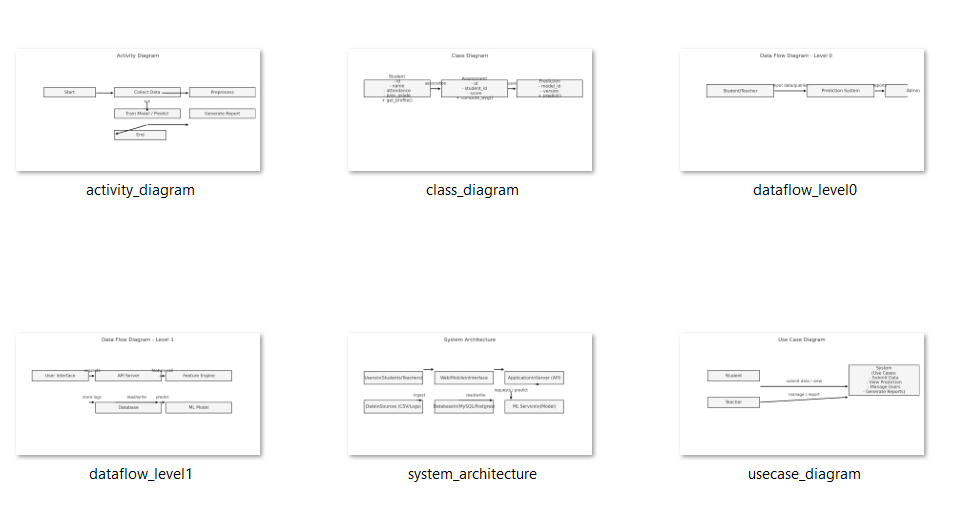
System Architecture Diagram
-
Data Flow Diagram (Level 0 & Level 1)
-
UML Use Case Diagram
-
UML Class Diagram
-
UML Activity Diagram
Final Project Structure
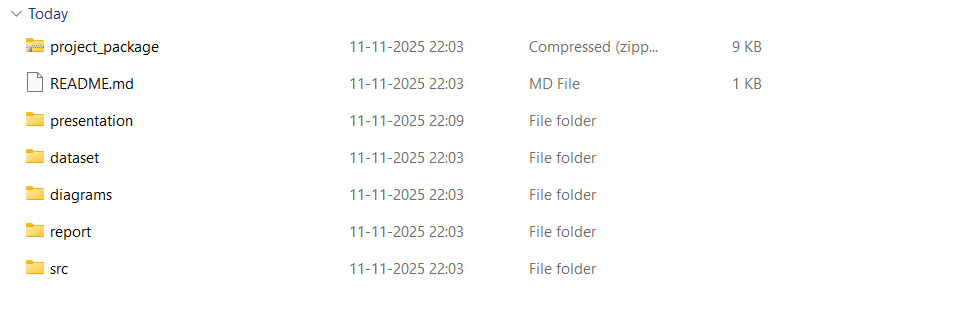
student_performance_project/
│
├── dataset/ # CSV dataset file(s)
│ └── student_data.csv
│
├── src/ # Source code
│ ├── train_model.py
│ ├── predict_app.py
│ ├── run_train.py
│ ├── requirements.txt
│
├── report/ # Full project report (Chapters 1–5)
│ └── Project_Report.pdf
│
├── diagrams/ # All diagrams as individual files
│ ├── system_architecture.png
│ ├── dataflow_level0.png
│ ├── dataflow_level1.png
│ ├── usecase_diagram.png
│ ├── class_diagram.png
│ └── activity_diagram.png
│
├── presentation/ # PowerPoint slides for defense
│ └── Student_Performance_Prediction_Presentation.pptx
│
└── README.md
Technical Details
1. System Requirements
Hardware Requirements
| Component | Minimum Specification |
|---|---|
| Processor | Intel Core i3 or equivalent |
| RAM | 4 GB or higher |
| Storage | At least 500 MB free space |
| Display | 1024×768 resolution |
| Optional | GPU (for larger ML datasets) |
Software Requirements
| Component | Description |
|---|---|
| Operating System | Windows 10 / Linux / macOS |
| Programming Language | Python 3.8 or higher |
| Libraries | pandas, numpy, scikit-learn, streamlit, matplotlib |
| Development Environment | VS Code / PyCharm / Jupyter Notebook |
| Database | CSV-based dataset (can be extended to MySQL) |
| Deployment Tool | Streamlit web framework |
2. System Modules
The system is divided into four main modules:
| Module | Description |
|---|---|
| Data Collection Module | Reads student data (attendance, assignments, grades, study hours) from a CSV or database. |
| Data Preprocessing Module | Cleans data, handles missing values, and normalizes features for model input. |
| Machine Learning Module | Trains and tests the Random Forest model to predict pass/fail outcomes. |
| User Interface Module | Streamlit-based web UI for users to enter student details and get real-time predictions. |
Expected Results
The model should accurately predict student performance with an accuracy of 85–90%. It should visualize prediction trends and highlight at-risk students.